A Double Feature for a Rainy Afternoon
Plan a rainy-afternoon double feature around one visual detail, then use a quiet pause to record how each film changes what you notice.
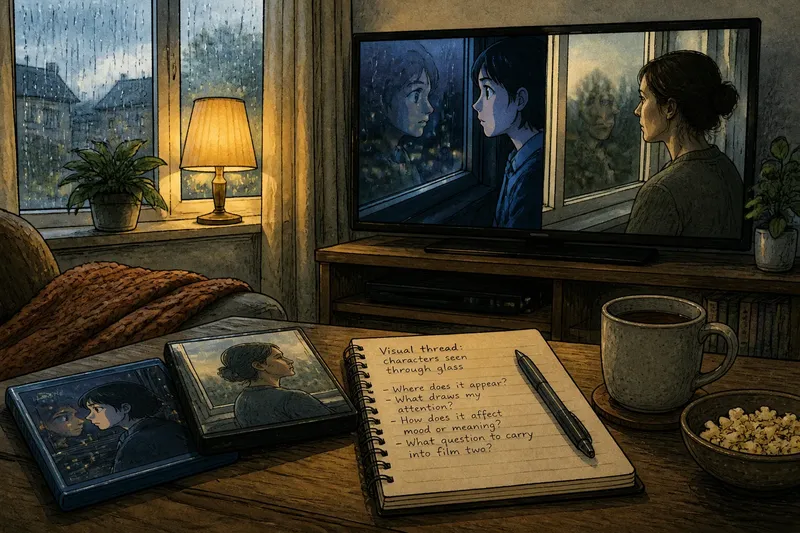
Rain taps the window while two film cases sit beside the remote. A rainy-afternoon double feature can begin with one small visual detail—a doorway, a red coat, a train window—and let two different films make something of it. The plan is simple: choose the detail, pair the films, and leave a short pause between them to write down what changed in your attention.
Choose a visual thread
Pick a detail you can recognize without needing the films to share a genre, era, or story. Look through your own discs, a library catalogue, or a streaming service’s descriptions and preview images. Useful threads include reflections in glass, patterned wallpaper, hands at work, a view through a doorway, or a color that keeps returning.
Keep the detail specific enough to notice but broad enough to appear naturally in both films. “Windows” may be too broad if you want to compare particular choices; “characters seen through a window” gives you a clearer question. A visual thread is like a bookmark: it helps you return to an idea without deciding in advance what the films must mean.
Choose a question to carry between the films, such as: Does the window make a character seem separated, watched, or free to look out? You do not need to predict the answer. The question simply gives your viewing a point of attention.
Pair the films
Choose films that handle the detail differently. One might use reflections to create uncertainty, while another uses them in a calm domestic scene. Or one film might frame a doorway as an invitation and the other as a boundary. The contrast gives you something to notice, but the films do not need to be opposites.
Check the practical fit before settling on the pair. Consider whether both are available to you, whether subtitles or a particular disc setup will affect how you watch, and whether their combined running time leaves room for a break. If you are watching with someone else, agree on the pair together or let each person choose one film while sharing the visual thread.
Say you choose reflections in glass and have an animated film and a quiet family drama available. You select one scene in each where a character’s reflection appears, then ask whether the reflection draws attention to the character’s surroundings or their own expression. The expected result is not a single interpretation; it is a more specific note about what each film asks you to see.
Set up the afternoon
Make the room comfortable without turning the plan into a production. Put the films in order, keep a notebook and pen within reach, and set out water or a snack before pressing play. If you are streaming, check that both titles are available on the same device or know how you will switch between services.
Decide in advance what will count as a worthwhile pause: a few minutes away from the screen, enough time to stretch and write a handful of lines. The pause is for noticing, not researching. Avoid looking up explanations or reviews between films; outside commentary can replace the first impressions you are trying to keep.
For a shared viewing, agree on a low-pressure way to take turns. Each person can write privately, or one can jot down both observations after a brief conversation. Leave room for someone to have noticed a different detail—or to have found the chosen thread less interesting than another part of the film.
Watch and pause
During the first film, watch normally. Do not scan every shot for the selected detail; let it appear when the film brings it forward. When you notice it, remember where it occurs and what surrounds it: a face, a room, a sound, a movement, or a change in the scene.
When the film ends, step away from the screen. Write a few short observations before starting the second film:
- Where did the detail appear?
- What did the framing or color make you notice?
- How did the detail affect the scene’s mood or meaning?
- What question do you want to carry into the next film?
Then take the break you planned. Stretch, refill a drink, or look out at the rain. A small reset helps the second film arrive on its own terms instead of feeling like an immediate continuation of the first.
Watch the second film with the same attention, not the same expectations. The shared detail may be obvious, subtle, or absent for long stretches. Afterward, write down what it does here and whether the second film made you revise your first note.
What should you compare?
Should the films share a genre?
No. A shared visual detail can connect films with very different stories or styles, and that difference may make each use easier to see. Choose a connection you can describe without needing a plot match.
What if the detail barely appears?
Record that absence rather than hunting for a forced match. You can note whether the film avoids the detail, uses it once, or makes another visual choice more compelling.
How long should the break be?
Make it long enough to write and reset, but short enough that you still want to watch the second film. A few quiet minutes can work; use your energy and the afternoon’s available time as your guide.
Can friends join without taking notes?
Yes. Ask each person to name one moment they noticed after each film, then let the conversation stop when it feels complete. Listening to another person’s observation can sharpen your own without turning the afternoon into a quiz.
Keep a small record
After both films, put your notes side by side. Look for a difference in framing, color, movement, or the relationship between the detail and a character. You might find that the same kind of window feels protective in one film and exposing in the other. If the connection turns out to be weak, that is still a useful note: the films may have held your attention for different reasons.
Write one sentence to preserve the pair, such as: “Both films used reflections, but one made them feel like distance and the other like self-recognition.” Add the film titles and the visual detail so you can find the pairing later. You do not need a polished review; a clear reminder is enough.
For your next rainy-afternoon double feature, reuse the format but choose a new thread. The value of this plan is not in building a perfect pairing. It is in giving two films a shared point of contact, then keeping a little space between them so each can answer in its own way.