The Scene-Only Rewatch Myth
The scene-only rewatch myth can blur a favourite film moment. Revisit its surrounding scenes to recover the cues that shape what you remember and notice.
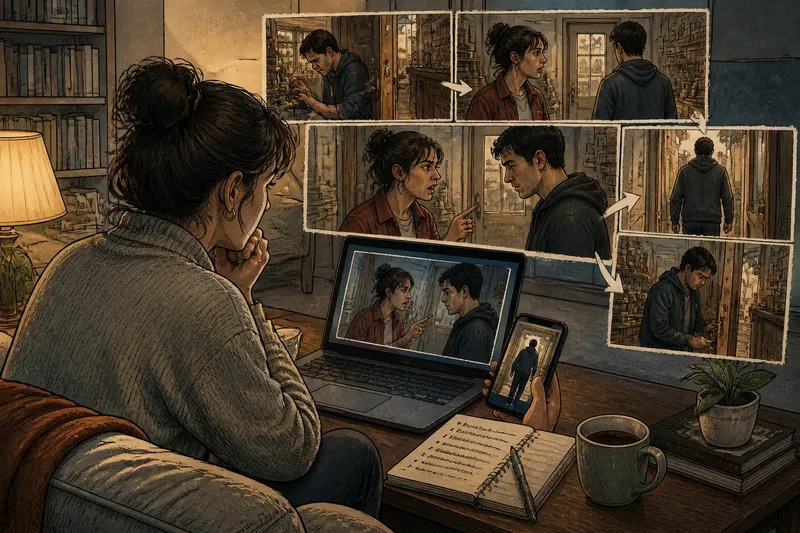
You open a clip of the argument you remember from a film: a slammed door, a face turned away, a line that still stings. The scene-only rewatch myth says this small return preserves the moment just as it was. But memory does not keep scenes in sealed compartments. What came before and after can change which details stand out, what the moment seems to mean, and even why it stayed with you.
That does not make a favourite clip useless. A scene can offer a quick, vivid return. The trouble begins when the clip becomes the only version you revisit, until your remembered moment gradually detaches from the film that gave it shape. A better rewatch need not mean sitting through the whole film every time. It means letting the scene keep enough of its neighbors to remain legible.
A remembered argument
Imagine Mara, an invented viewer, who remembers an argument from a fictional family drama called North Window. In the scene, Lena accuses her brother Tomas of leaving their mother to manage a failing neighborhood shop alone. Tomas looks down, says nothing, and walks out. Mara remembers Lena as fierce and Tomas as indifferent. The scene became her shorthand for the film’s family conflict.
Months later, Mara replays a short excerpt on her phone. The clipped version starts at Lena’s accusation and ends at Tomas leaving. It feels familiar, but this time she notices that Lena does not mention the shop’s latest crisis. She sounds as if she has been carrying this grievance for a long time. That observation complicates the old impression without overturning it.
Curious, Mara opens the film around the clip. Before the argument, Tomas has just spent the afternoon repairing a jammed door at the shop. Lena saw him there, but she also watched him leave before their mother arrived. After the argument, Tomas returns alone and quietly fixes the latch. The repair does not excuse his absence. It does, however, make his silence less like simple indifference and more like a choice he cannot explain.
Nothing in this invented situation proves that one interpretation is correct. Instead, the added moments give Mara more evidence to hold together. She can still see Lena’s anger as justified, while noticing Tomas’s mixed motives and the film’s attention to practical work as well as family speech.
What the edges change
A scene’s surrounding moments act like the margin around a photograph: they do not replace the image, but they can change how you read its boundaries. The scene itself may stay identical while its emotional weight shifts. A pause might register as defiance after one lead-in, embarrassment after another, or uncertainty when the next scene lets it linger.
Viewers also tend to remember a compressed version of an event. Mara’s memory kept the accusation, the silence, and the exit; it had dropped the shop’s broken latch and the order of events that made Lena’s grievance particular. That compression is ordinary. Our recollections preserve what felt important to us, not a complete record of every look, sound, and action.
Returning to the surrounding material can restore details that a clip leaves out: who enters first, whether a character has already tried to speak, what object remains in the room, or whether the scene cuts away before a response. These details can alter the remembered balance of a scene. They may also make a familiar performance feel newly precise, because a glance or hesitation now connects to something visible nearby.
Context can shift attention in the other direction, too. After seeing Tomas repair the latch, Mara might notice how often the film links care to maintenance and routine. That is not a secret meaning hidden in a single prop. It is a pattern she can check by watching other scenes and seeing whether the film returns to it.
Building a useful return
Mara does not need to replay the entire drama whenever she wants to revisit the argument. She can make a small viewing path that preserves the scene’s local context and gives her a chance to reflect. The aim is not to turn a casual rewatch into homework; it is to avoid letting a hard crop stand in for the full moment.
- Start with the remembered clip. Watch the version you usually return to, if you have it. Notice what you expect to happen and which detail draws your attention first.
- Find the scene’s entrance. Begin earlier, at a clear change in place, action, or conversation. Include enough lead-in to understand what brought the characters into the scene.
- Keep the full exchange. Watch through the scene’s actual ending rather than stopping at the line or gesture you remember. A reaction, silence, or cut may be part of the moment’s meaning.
- Continue into the next beat. Stay for the following scene or transition when it responds to what just happened. If the film moves elsewhere, that change may itself shape the scene’s effect.
- Compare the memory with the film. Name one thing your recollection included and one thing it left out. Keep the distinction between what the film shows and what you infer from it.
- Return to the favorite detail. Watch the focal moment again in context, then decide whether your original reading still fits. You can keep it, revise it, or leave the question open.
Say you, like Mara, have a saved clip of a character leaving a kitchen after an argument. You remember the departure as cold. Starting a little earlier reveals that the character had already offered to stay, while the next scene shows the other person declining to answer. Your revised memory might include both the hurtful exit and the unanswered offer, rather than replacing one with the other.
For a practical note, write down a few neutral prompts before watching: “Who speaks first?”, “What changes before the exit?”, and “What happens immediately afterward?” Neutral questions help you observe rather than hunt only for support for your first interpretation. You can keep notes in a phone app or on paper, but avoid recording a verdict before the surrounding material has played.
When the full film matters
Local context answers questions about a scene’s immediate setup and aftermath. Some meanings, though, depend on recurrence across the film. A gesture, a place, or an object can gather significance through repetition; an isolated excerpt may offer no way to tell whether it is a one-off detail or part of a pattern.
If a scene seems to echo another moment, revisit the earlier scene as well as the one you remember. Mara might recall that Lena had once shut the same shop door during a calmer conversation. Seeing both moments could make the later slam feel like a repeated habit, a deliberate change, or neither. The comparison gives her something concrete to consider rather than relying on a vague sense of familiarity.
Sometimes the best next move is to watch the whole film again, especially when its structure depends on delayed information, recurring images, or a later revelation. That need not be the default response to every favorite scene. Ask whether the question you have can be answered by the neighboring moments or whether it depends on a larger pattern.
Questions about scene rewatching?
How much surrounding footage should I watch?
Begin with the scene’s natural lead-in and ending, then include the next beat if it changes how the scene lands. If a line depends on earlier information, widen the viewing farther back until that information is clear.
Does context make my first reaction wrong?
No. Your first reaction records how the scene reached you at that time, while added context may explain or complicate it. You can preserve both responses instead of treating a changed interpretation as a correction that erases the original.
Can I still watch a clip just for comfort?
Yes. A familiar scene can be enjoyable or soothing without serving as a complete account of the film. The useful distinction is between returning for the feeling of the clip and claiming that the clip alone preserves everything the scene means.
What if I cannot find the scene’s exact boundaries?
Use a reliable copy of the film and follow the action until the conversation or sequence clearly changes. If you are relying on a short upload with missing material, treat your interpretation as provisional rather than assuming the excerpt contains the whole scene.
Keep the old reading
When Mara finishes her return to North Window, she has not traded her first memory for a definitive new one. She still remembers Lena’s anger and Tomas’s retreat, but now she also remembers the repaired latch, the earlier absence, and the silence that followed. The scene has become less tidy and more particular.
That is the useful limit of the scene-only rewatch myth: a clip can bring a moment back, but the neighboring moments help explain what has come back with it. When you revisit a scene that feels settled in memory, give it a little room on both sides. Then decide what you noticed, what you inferred, and which parts of your original response you still want to keep.